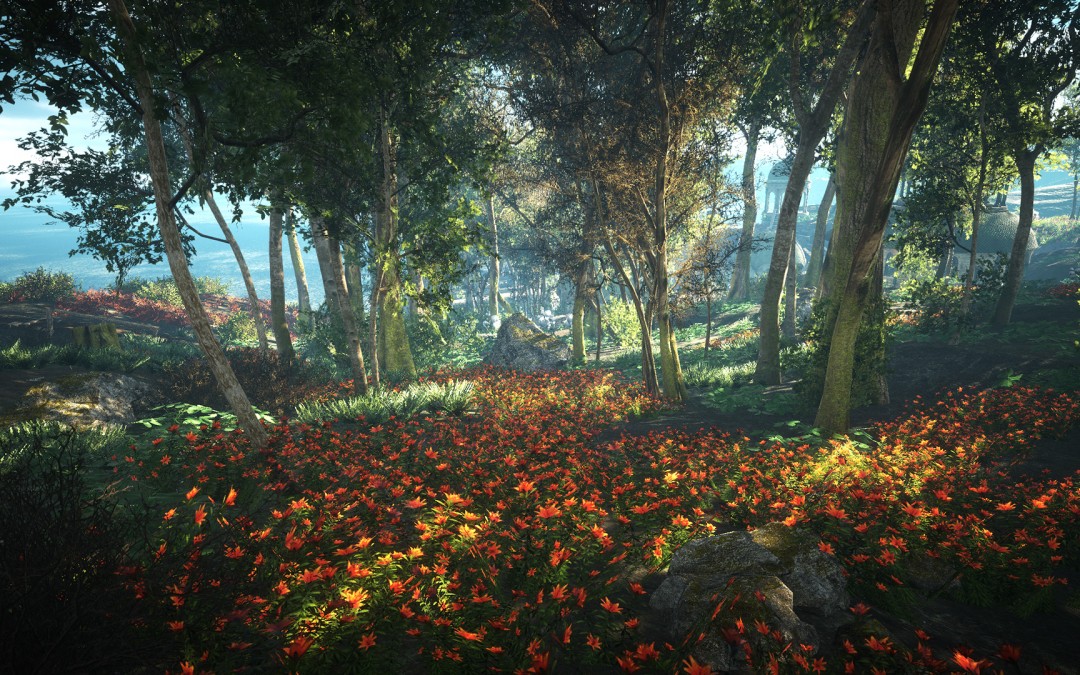
I want to clear the air about something. I’ve done a terrible job explaining what Eastshade is like to play. Part of that is because this project has been evolving over these two years, but the bigger reason is that my familiarity with the game makes me forget to talk about important points that nobody could possibly know. Jaclyn and I have concocted a concise explanation of what the game is:
“You are a traveling painter, exploring the island of Eastshade. Capture the world on canvas using your artist’s easel. Talk to the inhabitants to learn about their lives. Make friends and help those in need. Discover mysteries and uncover secrets about the land. Surmount natural impasses to reach forgotten places. Experience how your actions impact the world around you.”
Eastshade is a non-violent game; however, it’s not a game without mechanics, progression or goals. To me, a walking sim is a game that forgoes these things and focuses solely on atmosphere. Mechanically, Eastshade is a game that gives players the space to wander. We’ve made an effort to make the world feel alive and responsive as players explore. But there is also a clear sense of direction and progression. Here is a condensed description of the things you can do in Eastshade:
Meet the Inhabitants – Interact with the locals through dynamic conversations with discoverable topics and branching dialogue.
Capture Your Surroundings – Compose paintings anywhere in the world and offer them to characters to gain items, knowledge, and unlock secrets
Find and Craft – Acquire materials and schematics to surmount obstacles.
Interweaving Micro-Stories – Actions and dialogue decisions affect future interactions and outcomes as you meet new characters.
Story wise, Eastshade is not one particular tale that we were burning to tell. In order to allow the player to live the experiences we let go of orchestrating a controlled storyline and focused on building the world at large. To that end, Eastshade is filled with many little stories; each with their own effects and consequences on the state of the world. If you love the distilled sense of place that some walking sims have, Eastshade has it for you. However, if you weren’t a fan of Dear Esther or Gone Home, it doesn’t necessarily mean you will dislike Eastshade.
Hopefully that clears things up a bit, and hopefully the new landing page does a better job of giving newcomers the gist of what the game actually is.
We haven’t talked about it much in previous blog posts, but you play as an artist who can paint anything you see. Painting is core to the game. Inhabitants will commission paintings of certain objects, locations, at certain times, or weather conditions. Some puzzles are solved by making paintings with particular compositions. Painting in the game is kind of like taking a photo. Its a mechanic that rewards players for paying attention to the world they’re in.
The vertical slice, effectively a third of the game’s total content, is now at a point where it can be completed without console cheats (most of the time). Some testers have managed to finish everything there is to do (so far), without needing any direction or explanation. There is a game here, and it reportedly doesn’t suck. This is a joyous and momentous milestone!
There are still some placeholder assets and usability things to iterate on, and it will inevitably regress as we continue to make game-wide changes, but at this point the vertical slice is beta level, and we are ready to move on to the broader world of Eastshade! The great part about having polished one section is that we’ve worked out the design and built the framework which will carry us throughout the rest of development. As we were careful not to tangle ourselves in a tapestry of story dependencies, we will have a lot of freedom moving forward. Fresh starts are exciting! Especially when you feel you can attack with a honed strategy.
Unity 5.3’s new multi-scene features could not have come at a more perfect time. Everything now streams in as you walk around. There is only one quick loading screen when you start the game, and from there the world is completely seamless. The player can walk into new areas, caves, cities, and interiors without a hitch. Its also much easier to work in the world from an authorship side, because you can unload things you don’t need to see at the moment, and the editor stays light.
Content development is moving faster than ever at the moment. We have specialized and mature tools for authoring conversations and quests. We’ve settled on the game’s systems; they are implemented and working and we won’t add more. We’ve cut things that didn’t work, and revamped things that had potential. We’ve refitted content multiple times as we struggled to find the game’s center. The volatility is settling down now. All of the rest of the game’s content will manifest through the verbs we’ve established, enabling efficiency and better quest design. I’m excited to finally capitalize on the foundation we’ve been building for two years!
As we’re developing the game, having others playtest is invaluable and essential. We can hypothesize about how the flow of the game will go, but hypothesize is all we can do until someone else has played it. For Eastshade, there is one type of playtest that is particularly important: Not a speed run from myself or Jaclyn (who helps me with writing and design), not a thorough test for bugs or performance hot spots, but a tissue test! (I think kleenex test is the common way of saying it but I like the double T.) A tissue test is where you watch someone who has never played the game before, play without explaining anything or guiding them along. The more unfamiliar they are with your game and the less you speak while they play it, the better. They call it a tissue test because a someone can only be a first-time player once. As creators, we’re unable to see the game from fresh eyes; we know the hooks for every quest; we know where to find every item and we know every nuance of navigating the menus. Only from a tissue test can we can see if the UI is intuitive, or if a certain quest goal isn’t being communicated clearly enough.
Every few months, I’ve been trying to schedule a play test with a one or two folks who are unfamiliar with the game. As I’ve said before, I’m trying to be frugal with the amount of fresh eyes I use up, and I usually get so much feedback from just a few tissue tests that it keeps me busy for a month or more. Just recently, a test session took place (long over due!), and I’m happy to report it went astoundingly well! The content took longer to complete than anticipated, which is a good thing (as long as it wasn’t because something was unintentionally tedious or frustrating). The successful impact of certain quest moments filled my heart as a designer.
Despite these hopeful tidings, we still have mountains of work to do. We found we needed more gameplay “breadcrumbs” all around, to lead the player on the interesting paths. In fact, I’ve found there can never be too many breadcrumbs! As long as the hints are diegetic (in the actual game world rather than in a UI or something) and don’t spell things out too much so as to spoil the player’s sense of discovery, adding more breadcrumbs decreases the chances of the player getting lost or stuck.
In addition to the in-person play tests, I’ve attempted to give the build to some friends to test remotely, and I learned a valuable lesson from this: At this point in development, remote testing is far less fruitful than on-site testing! Without being able to see exactly how certain moments go down, I’m completely in the dark as to how to interpret feedback. In addition, the game has to be really polished for this kind of testing to be of any use at all. Little bugs or unfinished things can be devastating when the player has no idea what went wrong and I can’t be there to set things right with a console cheat.
Some days I look at the work left to do on this game and think “Who am I kidding? I’m in way over my head!” And other days anything seems possible. I find it hard to put a percentage on how complete the game is because of the volatile nature of production. The portion of the game currently being worked on is about a third of the total planned content, and this portion feels close to being done. Once this part is A-Z, the next section of the world will be kind of like Eastshade 2, because we can use the experience gained so far to go back to the drawing board with designing new content. So, onward we go!
In an altogether unfocused effort to share my development progress, I present… Dev Lapse 2! This one doesn’t document my culinary expertise, however, in this 10 minute production, I share part of my process for making a virtual building!